How to Separate Work and Personal Expenses
How to keep work and personal spending apart on one card: when a second account is worth it, how mixed expenses are split, and how to reach a percentage you can explain.
Updated: 2026-10-05
Short answer
Separation happens in the records, not in the wallet. A second account makes some things tidier but does not decide anything: a work card can still buy lunch, and a personal card can still buy a work laptop.
Give every expense a purpose at the time you record it: work, personal, or mixed. For mixed, record a work-use percentage and the basis you used to get it.
The basis is the part people skip and the part that matters. A percentage you can explain is a record. A percentage you picked because it sounded reasonable is a guess wearing a number.
Separate account, or one card and good records
Both work. They cost you in different places, and the choice is more about your business than about your bookkeeping.
| Second account | One card, tagged records | |
|---|---|---|
| Effort to set up | An application, and moving direct debits across | None |
| Effort per purchase | Choosing the right card at the counter, and getting it wrong sometimes | Tagging the purpose when you record it |
| Handles mixed expenses | No. A phone bill is still part work whichever card paid it | Yes, through a work-use percentage |
| Helps at tax time | A cleaner statement to start from | The purpose is already recorded, per expense |
| Worth it when | You have an ABN with real volume, or a bookkeeper reconciling for you | You are an employee, or a sole trader doing your own records |
Some business structures have requirements of their own about keeping business money separate. This is about record keeping, not about how your business must be set up.
Tagging an expense properly
Four decisions, all of them easier at the counter than in July.
Purpose first
Work, personal, or mixed. This is not a category. A laptop is Equipment either way; the purpose is what decides whether it belongs in your work records at all.
A percentage for anything mixed
Phone, internet, a tool used at home as well, a car park that was half a client visit. Recording a part-work phone bill as one hundred per cent work is the most common error in this area; a share is the truer record.
Write the basis down
A short note is enough: hours logged over four weeks, calls counted, jobs done, floor area. The number without the reason is the part that fails a question.
Attach the receipt
The purpose and the percentage describe the expense. The receipt is the evidence the expense happened. Keep them together or neither is much use.
How to arrive at a percentage
Pick something countable and measure it for a representative period, usually about four weeks. Hours the internet was used for work against total hours. Work calls against total calls. Days a tool was on a job against days it was in the shed.
Then keep it consistent. Using seventy per cent in one year and forty the next, with nothing recorded about why it changed, is worse than either number on its own.
Redo the measurement when something actually changes: a new job, a move to working from home, a tool that became mainly personal. Note the date it changed, and use the old figure up to then.
Round honestly. A percentage to two decimal places implies a precision your measurement does not have, and it does not make the record stronger.
A car is the exception
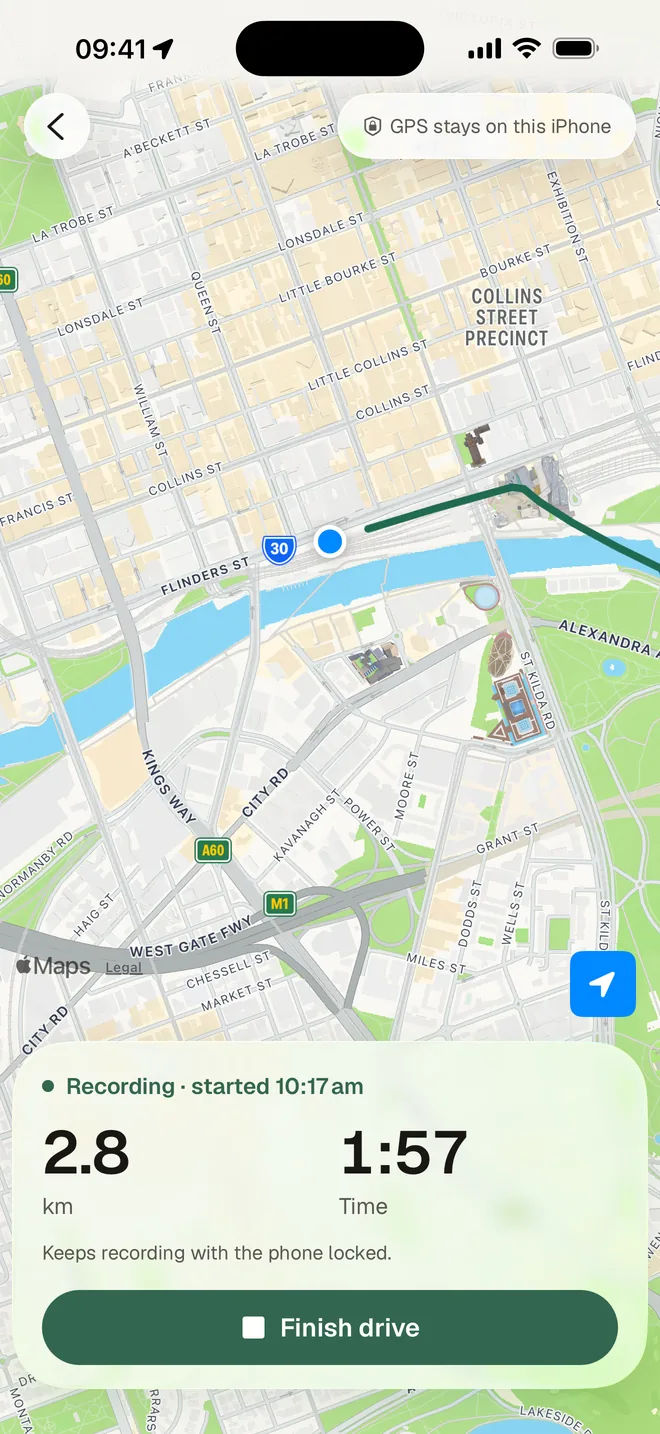
A car's work share does not come from a four-week estimate. Either you claim cents per kilometre for the work trips you record, or you use the logbook method, where a logbook kept for at least twelve weeks sets the percentage of the car's actual costs.
HeyJerni's Drive records each trip by GPS and keeps that logbook, so the trips are written down as you drive rather than reconstructed in June.
Do the arithmetic
The work-use calculator takes an amount and a percentage and shows the work portion, plus what it comes to across a year if the expense repeats.
It is a record-keeping aid. It does not decide whether the expense is deductible, or whether your percentage is reasonable for your situation.
Frequently asked questions
What is a work-use percentage?
Read next
Australian references
Last reviewed: September 2026. Tax information on this page is based on publicly available Australian Taxation Office guidance. HeyJerni is a record-keeping tool and does not provide tax or financial advice.

Tag it at the counter, not in July
HeyJerni puts a purpose and a work-use percentage on every expense, remembers what you chose per merchant, and keeps the receipt on the same record.
